
In Parable of the Sower, Octavia Butler imagines an alternative 2024 in which her young protagonist, Lauren Olamina, faces a social, environmental, political, and economic dystopia. While a charismatic candidate for president promises to “make America great again,” Lauren leaves behind her crumbling neighborhood to start a new community.
She prepares for this new beginning by packing her go-bag. This is her survival pack– “a grab-and-run pack.” She packs tools and pots, money, a canteen and water, matches, clothes, toiletry items, first aid supplies, food, journal, and plantable seeds. Once her bag was packed, she checked to make sure the water was still fresh, the food was edible, and the seeds could be planted.
Lauren Olamina and her go-bag have come to mind in the past month. I have had many conversations with clergy about what was causing them anxiety as preachers in this current moment of political division, Christian Nationalism, violence, and natural disasters. Their concerns were familiar and relatable: How can we preach effectively when our shared language and symbols are all in flux? How can we speak truth while holding a divided community together? How do we preach after election day, when half the people believe the country is doomed? What if we fail to meet this preaching moment and we regret our choices?
So, two weeks out from election day, what needs to be in your go-bag? What is essential for you in making your way through? What do you need to lead, teach, and preach?
1. What is your “why”?
The first thing we need in our go-bag is our why. Simon Sinek talks about the Golden Circle1 and says that successful leaders start with their why before figuring out their what or how. A leader’s why is their purpose, cause, or belief. Most of us know what we do. Some of us spend time considering how we do what we do. But our first step should be understanding and being grounded in our why.

Howard Thurman wrote about this idea calling it your working paper. You working paper is a “creative synthesis of what a person is in all their parts and how they react to the living process.”2 This synthesis requires us to be clear about what we are trying to do, what our guiding principles are, with what and why we will compromise, and to make sure we are using our own working paper and not someone else’s.3
Our why or working paper is the first thing that we should check to make sure it hasn’t changed or need updating.
2. What tools do you need?

Lauren made sure she had tools for cooking, chopping wood, starting a fire, and healing. She knew she needed to be ready for all sorts of circumstances, and needed different tools.
We all have a tool that is our go-to and that works for us in many situations. But if we only have one tool, we are limited in how we can respond. If all you have is a hammer, everything looks like a nail.4
In the coming months, clergy will need to use all of their tools–teaching, preaching, small groups, and one-on-one meetings. The tools that call for conversation and dialogue will be especially important for knowing where your congregation is in the midst of anxiety. We are not all at the same starting point when it comes to this conflictual season.
The folks behind Courageous Conversations suggest using their Compass as a check-in for yourself and your community. The four points are: (1) emotional – connecting/responding through feelings; (2) intellectual – connecting/responding through our best thinking; (3) moral – connecting/responding from a deep-seated belief; and (4) relational – connecting/responding through actions and behaviors. Ideally, we engage all four points – heart, soul, head, and hands, but acknowledging where we are starting from can help facilitate conversation and relationship.
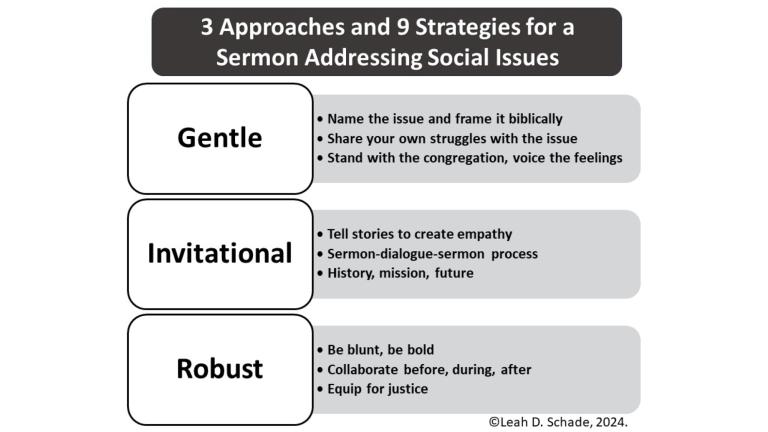
Now at some point, we will have to preach, and fortunately we have some different tools to use here too. Dr. Leah Schade offers 3 approaches and 9 strategies to use for preaching contentious issues. Choosing which approach and strategy to use depends on (1) your own vulnerabilities and strengths (2) the characteristics of the congregation you serve, and (3) the quality of relationships within the congregation and between the congregation and yourself.5
3. How will you care for yourself?
Lauren makes space in her go bag for self care items. She packs a comb, soap, toothbrush and toothpaste, and toilet paper. She brings her journal, her survival notes, and her Earthseed verses. In the midst of the end of the world, Lauren remembered to take care of herself.

We are preparing not just for a few days or weeks. It is very likely that the uncertainty and tension of the election season will stretch to the Inauguration in January 2025. Undoubtedly, our media is going to be in high gear reminding us of the uncertainty and conflict. [Nov. 5 – Election Day; Dec. 17 – Electors cast ballots; Jan. 6 – Electoral votes counted; Jan. 20 – Inauguration]
Now is the time to identify what practices you need ready to take care of yourself physically and spiritually. What is your exercise routine? What is your daily practice of prayer and study? Do you have a clergy group to share experiences and concerns? Do you have good food in the fridge? When will you rest? How will you make time for creativity? How will you have fun?
4. What are the seeds of hope that you will carry?

The most fascinating thing that Lauren packs are plantable seeds. When she checks her go bag, she checks the food, water, and seeds to make sure that all are still good. Among all her survival gear, Lauren carries actual seeds of hope.
Christians should be good at hope. In the Episcopal Church, we will soon be in a liturgical season that dares us to hope for the Kingdom of God even in the uncertainty of waiting. While hope should be part of our daily work, it is perhaps the easiest thing to get left behind. Certainly hope is easily lost in moments of anxiety and conflict, but we are still called to hope in Jesus Christ.
So as you pack your go-bag, what are the seeds of hope you will carry?
Resources for the journey
Books
Preaching in the Purple Zone: Ministry in the Red-Blue Divide, Leah Schade (2019)
Prophetic Preaching: A Pastoral Approach, Leonora Tubbs Tisdale (2010)
Resurrection Hope: A Future Where Black Lives Matter, Kelly Brown Douglas (2021)
The Crisis of Christian Nationalism: Report from the House of Bishops Theology Committee (2024)
Things on the Web
How can Christian leaders faithfully navigate politics?

Sermon: A city built on a hill
I was invited to preach and teach at a clergy gathering on the topic of preaching in the current moment. I chose Matthew 5:13-16 as the gospel, and focused on “A city built on a hill cannot be hid.” I explored how this image became part of our collective understanding of what it means for America to be an example to the world (aka, American Exceptionalism). America as a “shining city on the hill” has been used by presidents, and religious leaders, and even crept into the collects of the 1979 Book of Common Prayer. You can read the full sermon here.
- https://simonsinek.com/golden-circle/ ↩︎
- Howard Thurman. Jesus and the Disinherited. Beacon Press, Boston.1976, p. 100.) ↩︎
- Ellison, Gregory. (2020). My Working Paper: beyond the Mule’s Path. Pastoral Psychology. 69. 1-7. 10.1007/s11089-020-00921-6. ↩︎
- https://en.wikipedia.org/wiki/Law_of_the_instrument ↩︎
- https://www.patheos.com/blogs/ecopreacher/2024/09/preaching-2024-election-season-sermon-ideas-oct-6-13/ ↩︎
 Notoriously Episcopalian
One thought on “Preachers: is your go-bag ready?”